

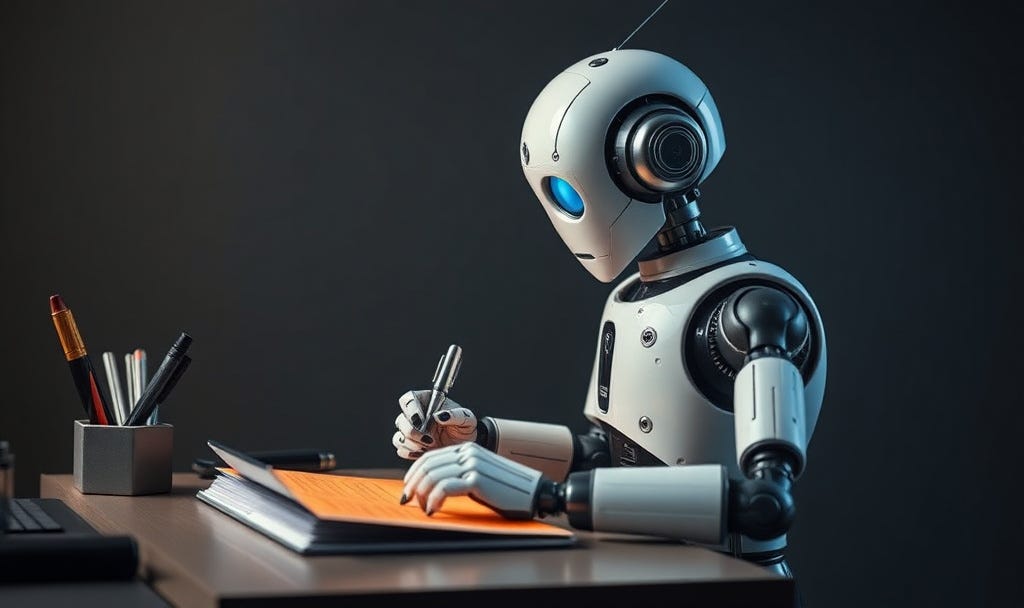
For some time now, I’ve been trying to avoid worrying about the effects of AI on writing. I finally have to admit it: I am officially concerned. So here is my contribution to the growing body of human-written efforts to deal with the fallout from the AI explosion. (Full disclosure: I generated the image for this essay using the AI feature offered by Substack. I just couldn’t resist…)
AI and I
Lately, I’ve been getting a tad obsessed about the whole AI thing. (Can you be “a tad” obsessed? I’m not sure, but somehow it feels right; I’m thinking it’s somewhere between “interested” and “frantic.”) I originally thought that I could ignore the infiltration of AI into the world of writing. By pure luck, I retired from my position as an English professor just before AI transformed the world of teaching, so I wasn’t subject to the potential catastrophe it’s introduced there. And the writing I now do is pretty much risk-free, given its lack of any necessary or even useful purpose. Then too, I haven’t actually been using chatbots for anything, at least not intentionally. I do often “ask The Google,” and that, I realize—as Google politely informs me—does involve the use of AI. But online searches have always used forms of artificial intelligence, well before anyone thought to give them first names. In any case, I haven’t signed up for it, paid for it, tested it, or experimented with it. (Well, maybe once or twice I did ask Google something I suspected would lead it to give me a wrong answer, just to make a point. It didn’t disappoint me.) On the other hand, what I have been doing is reading about AI—a lot.[1] My reading has primarily been focused on non-specialist but serious articles and essays in publications along the lines of The Atlantic, Quillette, and Persuasion—that is, publications that focus on serious articles and essays for non-specialists. The views I’ve encountered have ranged from the wildly (and naively) optimistic to the deeply (and depressingly) apocalyptic.
I was somewhat alarmed to read an essay in The Atlantic by one of its staff writers, who freely, even proudly, admitted to her use of Claude as a co-writer for her Substack posts—though not for the essay I was reading, given that The Atlantic, rightly in my view, doesn’t allow it. Considering that the writer’s field is emerging technology, I suppose I shouldn’t have been surprised. Along the same lines, as I was writing this essay, I saw an announcement for a newly published book about AI—co-written by Chat GPT-5. On the other hand, I’ve also read several AI specialists proclaiming that they will not, under any circumstances, enlist AI for their own writing. As someone who writes—and who cares deeply about writing—I now believe that I should be concerned. So I’ve decided to add my own voice to the chorus—before it’s too late.
I’ve noticed that my friends’, acquaintances’, and family members’ views vary as much as those I find in print—from a close friend’s cheery announcement that ChatGPT was of invaluable help in determining the ideal peacock blue to paint her bathroom to our software-engineer nephew’s predictions (in his darker moments) of Claude-Mythos-instigated doom. For many of them, as for me, it’s a dizzying see-saw between amazement at what AI is already doing and consternation at what it might soon be doing. Claude and its fellow AI companions have already proved their ability to mimic and, yes, surpass humans in producing (I refuse to say “writing” or “creating”) numerous types of written texts. Still, since my Jewish nature and heritage always prompt me to find the joke in the darkest corner, I can’t help but be amused as well. AI’s much-publicized errors and hallucinations have been hilarious, from Google Gemini’s female Asian popes and Nazis of color to an AI-invented summer reading list, complete with authors and brief descriptions of non-existent books, that unintentionally provided a true example of metafiction—a fictional list of recommended fiction.[2] I was also quite amused to learn that AI models, while they can closely imitate individual writers’ styles, do have a signature style of their own. Several perceptive readers have noted Claude’s tendency to use lots of em dashes; to overuse the “rule of three”: three examples, three cases, three sources (yes, that’s an example as well as a brief explanation); to frame a large number of its responses in a “not this, but that” construction; and to rely on annoyingly punchy one or two-word sentence fragments, also presented in groups of three, for emotional effect. Thanks to these clues, the august New York Times itself was recently exposed for publishing what was apparently a largely Claude-produced essay in its most human of features, the “Modern Love” column. Most tellingly, though, Claude indulges in a heavy, cloying use of obsequious flattery, constantly informing its human interlocutors of how smart, insightful, absolutely right, and cute and stylish in that new outfit they are. (Okay, I made up that last one.)
I have had one direct experience with Claude’s work. When a friend sent his fairly complex question in the field of linguistics and lexicography along with Claude’s impressive response to demonstrate its amazing ability, I was far more interested in discovering that nearly all of those stylistic quirks were in fact present—and then in writing a response that shamelessly imitated them. As I said at the time, my parody took a lot longer than Claude’s would have—but I’m sure I had more fun.
It’s true that the gaffes are becoming less frequent as well as less funny (and less “creative”) as the AI models are fed more and more data and learn from more and more users.[3] I am aware as well that users can ask Claude to eschew specific stylistic devices (no sentence fragments, please!) and tone down (or tune out) the praise. The trick of course is that far from deleting these features, most users will prefer to have them—and come back for more. Like social media, AI already has the recipe for its increasing use embedded in it.
A huge part of the AI appeal is, ironically, its imitation of humanness. It was, after all, created by humans. And while some anthropomorphism is inevitable, at least as much is clearly intentional. In spite of their owners’ protestations to the contrary, no one would think to give an LLM or a robot—or a chimpanzee for that matter—a human name without intending and expecting us to respond to it as a fellow human. In my earlier referenced rejoinder to an AI-generated text, I included a question about Claude’s preferred pronouns. Would Claude rather be referred to by it/it/its or he/him/his? My nephew indulged me by asking Claude directly. Here’s what came back:
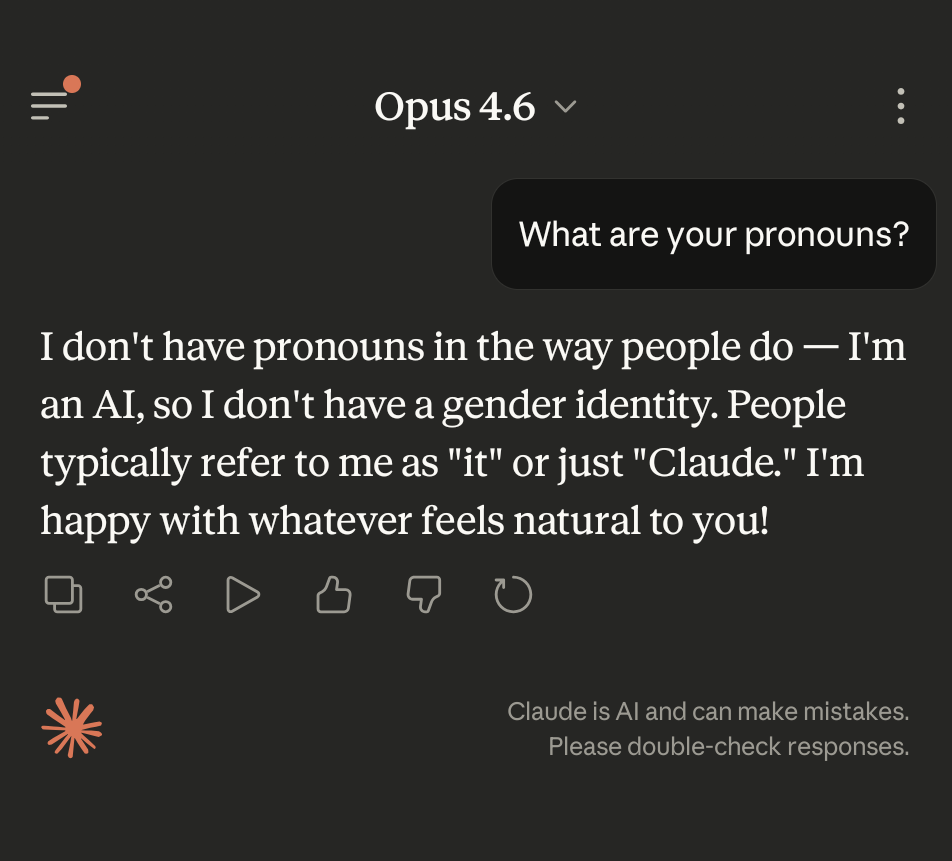
So Claude openly admits that it is not human and has no gender identity—but then goes on to add that it can be made happy? Really? You can make a non-sentient, non-living thing happy? If so, I wonder if my computer is happier when I put it to work as I’m doing now or just leave it alone and go wash the (soon to be clean and happy) dishes.
Still more concerning is the tendency of AI to provide opinions, even when users don’t ask for them. In its response to the linguistics question, Claude did not only provide a lot of specific and reliable information my friend had requested. The chatbot went on to draw conclusions my friend had not requested. True to form, those conclusions were presented in three short paragraphs, each one employing a “not this, but that” construction. But they were also notable for their entirely sanguine, all-manner-of things-will-be-well approach to an issue that many human thinkers have presented as far more concerning, more ambiguous, and even more threatening to human wellbeing. None of that was mentioned in the AI-produced response. Claude’s metaphorical glass is clearly half full. It appears that chatbots want us to feel good about ourselves as we give up our autonomy to them.
I, naturally, can do nothing at all to stop or slow the AI onslaught. But I can think about my relationship with it, make at least some of my own decisions about using it, and try not to become a tool of the tool. Very recently, speaking to a friend who is a prominent academic writer, I found that she and I agreed on how best to do that. So I’m going to use HI (I’m sure you can figure that one out) to put forward two major guidelines for writing with (and without) AI. These are also the guidelines I would like to see other writers and publishers adopt.
1. I will accept and make use of AI for information-gathering and (in my case, non-specialist) research. But I will check and check again before accepting or making use of any information I’ve thereby obtained by going to actual, original sources, looking for supporting evidence, doing whatever it takes to ensure the information is reliable. Even ChatGPT, Gemini, and their ilk remind us that they are AI and subject to error. (See the fine print in Claude’s response regarding gender identity above.) But that’s pretty obviously just CYAI. It’s up to us to remind ourselves. As it turned out, I used only human knowledge and experience in writing this essay. Of course, human knowledge and experience are also prone to error—something the techies love to point out. I do follow the same policy for ascertaining correctness no matter what the source. But while in this instance I didn’t, I might have checked in with AI to, say, help me recall where I first read about the Gemini slip-ups or provide an explanation from Anthropic on the significance of its name.[4]
2. I will not use AI to write or assist in my writing in any way: generating topics, planning, drafting, reviewing, revising, editing, etc. I can understand its draw for people who aren’t writers but who, for whatever personal, job-related, or other reason, want to produce something in writing. Instead of a ghost writer they can now use a ghost LLM (an LLG?). But I don’t see why people who are actual writers would enlist someone or something else to do the writing for them—even something that can perfectly imitate their personal style. The process of writing is at least as important to me as the product. Why else would writers so often write things they don’t plan to publish or even share? (Looking at you, Emily Dickinson.) Besides, we’re the ones AI is learning (and has stolen) from. That unauthorized use has been confirmed both by The Atlantic’s ambitious but far-from-exhaustive attempt to hold AI companies responsible and by the legal settlement involving Anthropic that is expected, in fact, to result in some payment to the writers whose works it downloaded and used without permission. Thanks to those sources, most of my writer friends, my husband, and I know that we have books on the ever-growing list of written works ingested by the insatiable maws of LLMs. I guess some might see it as a tit-for-tat thing: you used me, now I’ll use you. But I don’t want to write—or to read—what some conglomerate of human and non-human “thinking” has to say on a subject. I want to hear what I think and to discover my own way of saying it—and to read what other individual writers have come up with on their own.
I realize that for many people, writing is a source of income or the only way up the corporate or academic-tenure ladder. Maybe for writers in those situations, such artificial assistance is now de rigueur. And at this point, we are pretty much on an honor system: AI use has become harder and harder to detect or trace. (Anyone who’s been involved with an honor system in a university setting probably knows how scandalously unreliable they are.) But I still think these two principles might help stave off some of the current AI-created issues for readers and writers. For myself, I’ll be limiting my reading to those publications that follow them and those writers I trust to do the same.
In any case, whether I’m reading, writing, or trying to figure out what to wear to an outdoor ranch wedding, I will try to be aware and vigilant regarding the use of AI. I know I will have to make a conscious effort to avoid what I’m designating as AI Creep—including those algorithms that constantly track our every screen-related movement. I do find it humorous that Netflix frequently suggests shows based on my nine-year-old great-niece’s tastes; I am not in fact the person who watched Gabby’s Dollhouse or K-Pop Demon Hunters. (Oh wait, I did watch that one…) And, thanks largely to my teaching and gift-giving, Amazon lists a wildly eclectic assortment of potential reads selected especially for me. But whatever they know or don’t know about me, I have hope that I will continue to know—and to be—myself.
[1] Please understand that I’m not talking here about the use of AI in software coding, medical diagnosis, or divining the creation of the universe. I’m focusing on the areas of most interest to me, that is, reading and writing.
[2] We humans, of course, provide our own opportunities for unintentional humor, some of which AI has, as an unintended consequence, now deprived us of. Think, for example, of those delightful instructions that used to come with Asian-made products suggesting to please, madam, to remove the plastic covering before to apply the leggings to your body. (Let me apologize if that sounds unkind—I am aware that any Chinese speaker’s English language skills are far superior to my Chinese. Still, I can’t pretend that I didn’t enjoy the results of those efforts.)
[3] I can’t help noticing a comparison to Covid vaccine research. In both cases, the studies have proceeded far more quickly than might have been expected due to the huge amount of immediately available data we’re providing, willingly or not. But in the case of Covid research, I’m entirely grateful.
[4] The word anthropic, as I know from my long-ago study of ancient Greek, means related or pertaining to humans. I recently read an article explaining that Anthropic’s name relates to its original purpose; it broke off from OpenAI with the laudable intention of being more sensitive and responsive to human concerns. The article also suggested that in spite of such noble beginnings, the urge to go as far as possible in the tech world consistently gets the better of the urge to resist. In that light, the name might end up having far darker implications. But please don’t think I’m suggesting anyone should therefore threaten any AI CEO’s health and safety…
Wow, it “read” the book cover. It could have just asked me! 😉
Best title ever! I have to admit I’m one of the “What color should I paint the bathroom?”users. I’ll share my ChatGPT requests with you sometime, and we’ll have a good laugh. If you write the honor code, I’ll happily sign it on behalf of myself and ROMAR Press.